Dr Crosby speaks at Asia-Pacific Myopia Management Symposium 2026 in Tokyo
Dr Niall Crosby was invited to speak at the 6th Asia-Pacific Myopia Management Symposium (APMMS), held in Tokyo, Japan.
The APMMS brings together eye care professionals from across the region to discuss childhood myopia, myopia control, and the long-term eye health consequences of progressive myopia.
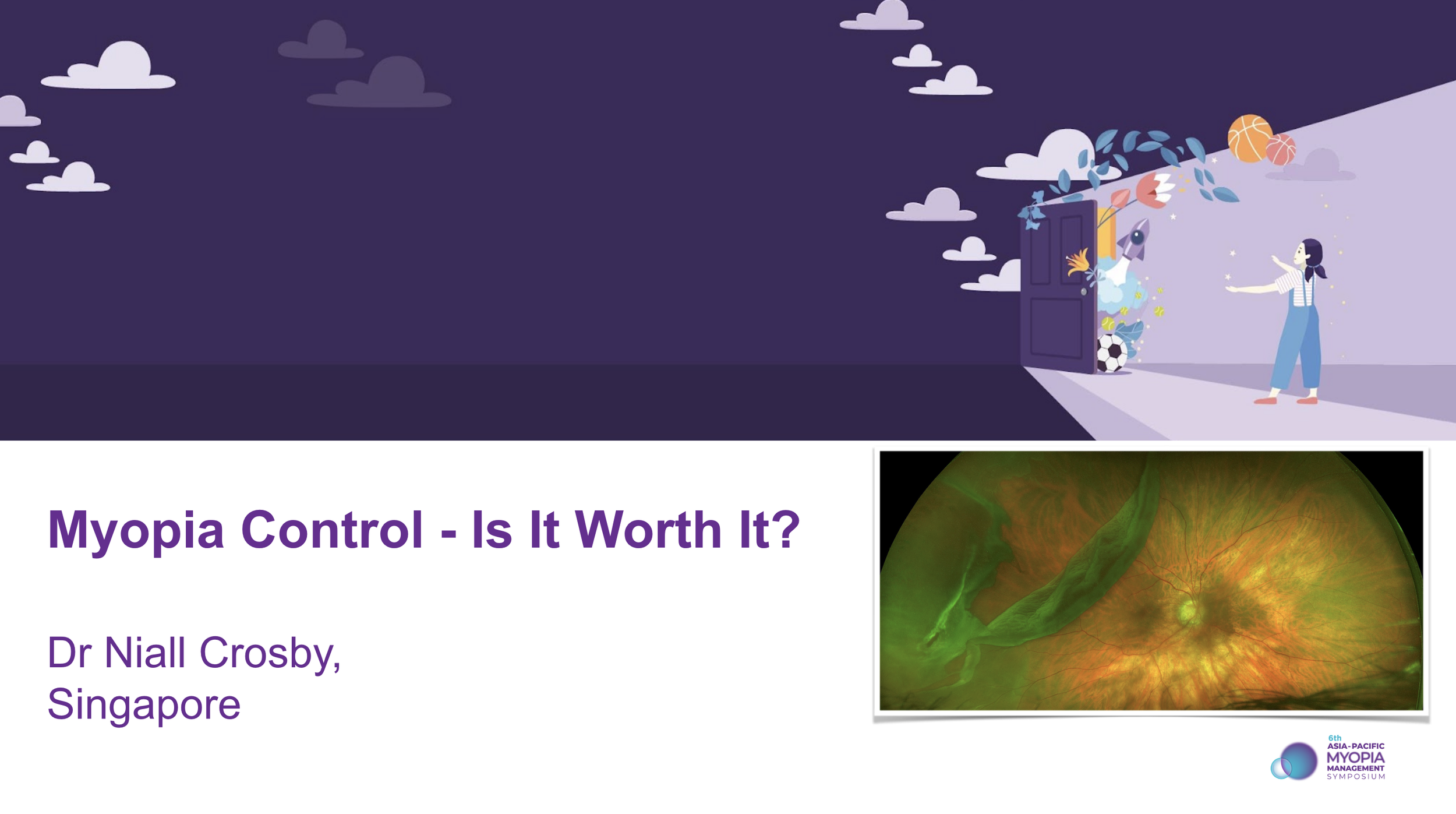
Video: Watch Dr Crosby’s APMMS 2026 talk on myopia control and long-term retinal risk.
Key points from the talk
Myopia control is about long-term eye health, not just reducing glasses prescription.
High myopia can increase the lifetime risk of myopic macular degeneration, myopic choroidal neovascularisation, retinal tears and retinal detachment.
Prevention may look excessive before the complication it helps to reduce.
Myopia control cannot reverse existing myopia or guarantee that progression will stop, but it can slow progression in many children.
The best approach depends on the child’s age, prescription, progression rate, lifestyle and risk factors.
Dr Crosby’s talk asked a practical question that often arises in clinic:
Is myopia control worth it?
For many families, myopia control can feel inconvenient, expensive or excessive. Children may need daily eye drops, specialised spectacle lenses, contact lenses, orthokeratology, more outdoor time, regular reviews, or repeated axial length monitoring. The benefits are also not always immediately visible.
To explore this, Dr Crosby used the example of the tsunami seawall in Fudai, Japan. The wall was criticised when it was built because it seemed unusually large and costly. Decades later, during the 2011 tsunami, it protected the town while nearby areas with lower walls suffered severe damage.
The lesson was simple: prevention can look excessive before the event it prevents.
Dr Crosby applied this idea to myopia control. A child’s short-sightedness may appear to be “just a glasses problem” at first. However, higher levels of myopia are associated with a greater lifetime risk of sight-threatening conditions, including retinal tears, retinal detachment, myopic macular degeneration, glaucoma and cataract.
Why a retina specialist cares about myopia control
As an ophthalmologist with fellowship training in both vitreoretinal surgery and medical retina, Dr Crosby often sees the later consequences of high myopia. These consequences can appear many years after childhood myopia first developed.
The talk discussed how myopia can increase vulnerability across a lifetime. A longer, highly myopic eye is structurally different. The retina and choroid may become stretched and thinned, the vitreous may detach earlier, lattice degeneration may be more common, and some patients develop degenerative changes at the macula — the central part of the retina responsible for detailed vision.
These changes can affect vision in different ways. Some patients develop retinal tears or retinal detachment. Others develop myopic macular degeneration, myopic choroidal neovascularisation, macular atrophy, foveoschisis or macular hole. These are not simply “strong glasses” problems; they are structural changes within the eye.
Dr Crosby also discussed real-world examples of difficult myopia-related retinal disease, including cases where treatment decisions were not straightforward and where prevention would have been preferable to later intervention.
Myopic macular degeneration
Myopic macular degeneration is one of the important long-term complications of high myopia.
It affects the macula, which is the part of the retina used for reading, recognising faces and seeing fine detail. In some patients, high myopia can lead to thinning and degeneration of the macula over time. In others, abnormal new blood vessels may grow beneath the retina, a condition known as myopic choroidal neovascularisation.
Treatment can help some complications, particularly myopic choroidal neovascularisation, but not all forms of myopic macular damage are reversible. This is why prevention and slowing myopia progression in childhood are important.
The aim of myopia control is not only to reduce the need for stronger glasses. It is also to reduce the chance of a child developing high myopia and the associated lifetime risk of myopia-related eye disease.
Retinal detachment and high myopia
Retinal detachment can often be repaired surgically, but surgery is not always simple and outcomes are not guaranteed.
In clinic, Dr Crosby explains to patients that retinal detachment surgery is usually successful, but some patients require more than one operation. In a small number of cases, scarring on the retina can make reattachment difficult, and final vision may remain limited.
This is one reason myopia control matters. The aim is not just to reduce dependence on stronger glasses. It is to reduce the chance that a child develops high myopia and the associated lifetime risk of eye disease.
Prevention is better than cure
The central message of the talk was that myopia control should be understood as long-term eye health protection.
The benefits may not be obvious immediately. A parent may not see the retinal detachment, myopic macular degeneration or other complication that was prevented decades later. But that is exactly the point of prevention.
Myopia control does not reverse myopia that has already developed, and no treatment can guarantee that progression will stop completely. However, evidence-based approaches can help slow progression in many children.
These may include:
increased outdoor time
sensible screen and near-work habits
low-dose atropine eye drops
myopia-control spectacle lenses
myopia-control contact lenses
orthokeratology in suitable children
regular monitoring of prescription and axial length
The most appropriate approach depends on the child’s age, prescription, rate of progression, lifestyle, family history and ability to use treatment safely.
A regional challenge
Myopia is common across many parts of Asia, including Singapore and Japan. As today’s myopic children become tomorrow’s adults, the long-term burden of myopia-related eye disease is likely to become increasingly important.
This makes education, early detection and appropriate myopia control an important part of protecting future eye health.
Further reading
Myopia Profile published a short summary of Dr Crosby’s APMMS 2026 talk on LinkedIn. Healthcare Asia Magazine also covered the talk, focusing on childhood myopia in Singapore and the importance of prevention, monitoring and treatment.
Parents who are concerned about their child’s myopia, increasing prescription, or risk of high myopia can arrange an eye examination to discuss monitoring and suitable myopia control options.